
Views: 0 Author: Site Editor Publish Time: 2026-04-21 Origin: Site
Manufacturing relies heavily on precise metal forming. Yet, turning flat sheet metal into perfect geometric profiles remains a complex physical challenge. For production managers, manufacturing engineers, and procurement teams, understanding how a bending machine works goes beyond basic mechanics. It serves as the foundation for specifying equipment, preventing material scrap, and optimizing cycle times. Consistent, high-tolerance bending is never achieved by raw force alone. It requires precise synchronization between hydraulic or electrical power delivery, tooling geometry, and real-time material compensation.
Every successful bend represents a delicate balance of applied pressure and material resistance. In this breakdown, we will demystify machine mechanics, digital control systems, and tooling logic. We will also explore the critical structural differences between linear press brakes and continuous roll-forming equipment. Read on to master the operational principles that drive flawless fabrication on the factory floor.
Force Delivery:Modern hydraulic systems operate on a precise four-stage cycle (rapid descent, working pressure, hold, and regulated return) to maximize efficiency and protect tooling.
Tooling Over Tonnage:The physical outcome is dictated largely by die selection. Applying the industry-standard "8x material thickness" rule for V-dies is critical to preventing flat stock from cracking.
Machine Architecture Variations: A press brake relies on linear vertical force, whereas a **roller bending machine** utilizes continuous, gradual pressure accumulation to form radii without single-point stress.
Defect Compensation: High-end CNC bending systems actively counteract material realities—such as springback and machine deflection (crowning)—achieving angular accuracy down to +/- 0.2°.
Before you can optimize a fabrication process, you must understand how equipment generates and translates power. Machines do not simply smash metal into shape. They apply controlled, calibrated force through highly engineered drive systems. Demystifying this power generation cycle helps operators troubleshoot inconsistencies and helps engineers match machinery to specific production tolerances.
Traditional manufacturing setups typically utilize hydraulic systems. These systems rely on oil pumps, large reservoirs, and directional valves to drive heavy cylinders downward. They offer immense raw power suitable for thick plates. However, modern electric and servo-driven machines are rapidly changing the landscape. Servo-electric models use heavy-duty ball screws and precise electric motors. They eliminate hydraulic oil maintenance, run quieter, and offer superior energy efficiency. While hydraulic setups dominate heavy industry, servo-electric models excel in high-speed, precision-critical environments.
For standard hydraulic systems, power delivery is never a single, uniform motion. To maximize efficiency and protect the tooling from impact shock, the kinematic cycle follows a standardized four-stage operational flow:
Rapid Descent: To save cycle time, the upper slide drops rapidly toward the material. It uses gravity and low-pressure fluid flow rather than active motor pushing. A pre-fill valve opens, allowing the cylinder to fill quickly.
Working Speed (Pressing): Just above the material surface, a limit switch triggers the engagement phase. The system slows down significantly. Full tonnage is now applied at a highly controlled speed to deform the metal safely.
Holding (Bottom Dead Center): Once the machine reaches the programmed stroke depth, it holds the position momentarily. This brief pause sets the bend and allows internal material stresses to stabilize.
Return Trip: Decompression valves open to release pressure smoothly, preventing shock to the frame. The slide then returns to its upper resting position. Manufacturers typically calibrate this return cycle around a stable 120kg/cm² system pressure.
Modern industrial PCs govern every millisecond of this cycle. Advanced CNC units translate raw CAD data into exact stroke depth calculations. They read the intended angle, account for the material profile, and command the valves accordingly. This automation eliminates operator guesswork. A well-calibrated CNC system manages ram positioning with accuracy down to +/- 0.1 mm, ensuring repeatable results across large production runs.
A common mistake on the production floor is blaming the machine for poor bend quality. In reality, operator technique and die selection matter far more than raw machine capacity. The tooling interface represents the exact point where mechanical force meets material reality. If you use the wrong tooling, no amount of CNC precision will save the part.
Operators generally employ two primary forming methods, but one dominates modern manufacturing. You must understand the distinction to protect your equipment from premature wear.
Process | Contact Points | Tooling Dependency | Tonnage Required |
|---|---|---|---|
Air Bending | 3-point contact (punch tip, two die shoulders). | Flexible. One die can create multiple angles. | Relatively low. Ideal for preserving machine life. |
Bottoming | Full conformity to punch and die geometry. | Rigid. Needs a specific die for every specific angle. | Extremely high. Strains hydraulic systems heavily. |
Most modern operations rely on air bending for its flexibility. Because the sheet only touches three points, operators can adjust the punch depth to achieve different angles without changing the lower die. Conversely, bottoming forces the material to conform entirely to the die cavity. This requires massive tonnage and places severe strain on machine hydraulics.
Choosing the correct V-die width is the most critical calculation in metal forming. The fundamental industry standard is the "8x material thickness" rule. If you bend a piece of 3mm sheet metal, you must select a V-die opening of roughly 24mm.
Why does this matter? Forcing thick or high-tensile materials into narrow dies concentrates immense stress on the outer radius of the bend. This is the primary cause of material cracking and rapid tooling fatigue. Alternatively, using a die that is too wide will create an excessively large inside radius, throwing off your dimensional tolerances.
Standard V-dies cannot handle complex geometries. Engineers frequently rely on specialized profiles to clear tight clearances. Gooseneck dies feature a scooped-out shape, allowing them to form tight-return flanges without colliding with the previously bent metal. Furthermore, tube bending requires internal support. Operators use precise internal mandrels to prevent the inner walls of a pipe from collapsing or wrinkling during intense compression.
Buyers evaluating different machine categories must understand that different geometries require completely different mechanical physics. Attempting to force one machine to do another's job leads to ruined material and unsafe conditions.
A standard press brake uses single-axis vertical punches. It drives a tool straight down into a die, making it perfect for sharp angles, brackets, and box flanges. However, it cannot efficiently create large cylinders or sweeping curves.
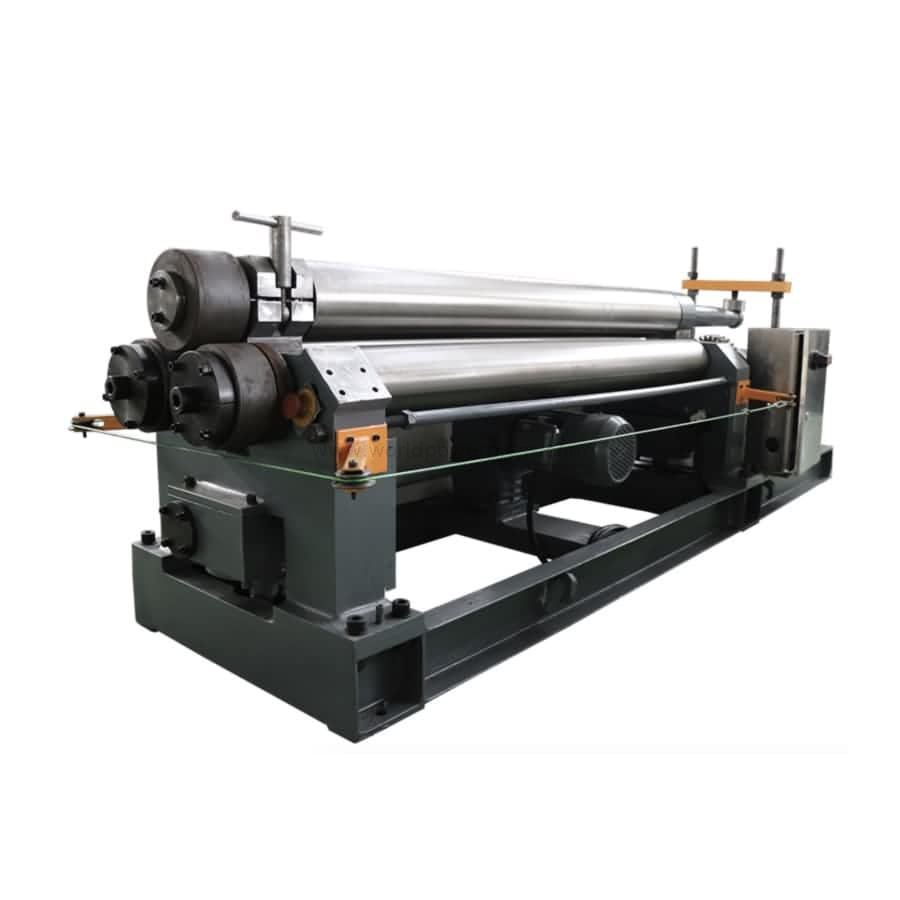
For large radial curves, a roller bending machine relies on a pyramid mechanical structure to bend material gradually. Instead of a single vertical strike, it utilizes continuous rotary pressure. The upper and lower rollers pinch the metal sheet, feeding it through the machine while accumulating deformation over multiple passes. This method forms wide radii without subjecting the metal to single-point stress.
Operating a roll bender requires a different mindset. When flat metal enters the rollers, the distance between the pinch point and the machine's side rollers leaves a short, unbent flat section at the beginning and end of the sheet. If operators simply roll the sheet into a cylinder, these flat edges will meet at the seam, creating a visible flat dead-zone.
To avoid this, operators must perform "pre-bending." They specifically target the leading and trailing edges of the material, curving them before feeding the entire sheet through the main rolling cycle. This is a common failure point for beginners who mistakenly apply linear press-brake logic to a continuous roller bender.
Metal is not clay. It resists deformation and attempts to return to its original state. High-end equipment distinguishes itself by actively solving these structural realities during the fabrication process.
When metal bends, a tension and compression paradox occurs. The outer fibers of the bend stretch, while the inner fibers compress. Once the punch retracts and the pressure releases, the stretched fibers pull back slightly. We call this elastic recovery "springback."
An operator cannot simply program a 90-degree angle and expect a perfectly 90-degree part. High-end machines resolve this by using real-time angular measurement systems. Laser sensors or physical probes measure the angle as it forms. The CNC software then calculates the exact amount of over-bending required. The machine might bend the metal to 88 degrees, knowing it will spring back precisely to the target 90-degree mark.
Every piece of heavy machinery flexes under extreme pressure. This creates a severe issue known as the deflection paradox.
The Problem: When applying heavy tonnage across a long piece of sheet metal, the machine bed physically bows downward in the middle. Because the center of the bed drops slightly, the punch does not penetrate as deeply into the material at the center as it does at the rigid ends. This creates a defective part with bends that are acute on the ends but shallow in the middle.
The Solution: Equipment manufacturers counter this with crowning systems. These mechanical or hydraulic systems intentionally shim the center of the lower bed upward. By introducing a deliberate convex curve to the bed before the bend starts, it perfectly cancels out the bowing effect under pressure. CNC-controlled crowning guarantees uniform bend angles across exceptionally long parts.
Procurement teams need a definitive decision framework before selecting a new machine setup. Misjudging specifications leads to immediate operational bottlenecks. If you are preparing to evaluate a bending machine, focus on these strict evaluation criteria.
Never buy machinery based on raw capacity alone. Many buyers mistakenly purchase massive tonnage expecting it to handle anything. However, excessive tonnage on a small frame can compromise accuracy. You must calculate the required tonnage per foot. This metric is dictated by the material type (mild steel vs. stainless), the length of the part, and your intended V-die width. High-tensile alloys require dramatically more force over the same distance compared to standard aluminum.
Evaluate the operating logic of the control system. Basic machines rely on simple stroke measurement. You program the ram to descend a specific distance, and you hope the angle is correct. If the material thickness varies slightly from batch to batch, the angle will change. Conversely, systems utilizing active angular feedback loops measure the actual part in real-time. These advanced systems deliver +/- 0.2° accuracy, drastically reducing test-piece scrap.
Consider the viability of Industry 4.0 setups. Standalone machinery isolates data. Modern floor integration involves networking the fabrication equipment with upstream punching or laser-cutting stations. By sharing CAD/CAM databases, engineering teams minimize interface management costs. When the laser cutter adjusts a blank profile, the press brake automatically updates its back-gauge positions to match.
Establish non-negotiable operational specifications for daily maintenance. Hydraulic setups require strict environmental controls. You must maintain hydraulic oil temperatures between 15°C and 60°C. If oil runs too cold, it becomes thick and sluggish, throwing off ram positioning. If it runs too hot, seals degrade rapidly. Furthermore, mandate regular pressure gauge validations and secure safety light curtains to protect operator extremities during the rapid descent phase.
A modern bending machine is never a blunt instrument. It operates as a highly synchronized system where mechanical force, tooling geometry, and digital compensation interact continuously. True fabrication success depends on mastering the nuances behind the equipment, from understanding hydraulic cycle limits to respecting the tension of metal fibers.
Procurement and daily operation hinge on aligning your exact requirements with the right hardware. You must choose the correct machine architecture, whether that is a linear press brake or a continuous roller system. Furthermore, leveraging CNC capabilities like active crowning and automated springback correction will instantly elevate part quality.
Before finalizing your machine sizing and specification requirements, assess your current production data. Review your daily scrap rates, audit your existing tooling inventory, and measure your longest part lengths. Accurate internal data is the strongest foundation for selecting machinery that will genuinely optimize your floor's output.
A: Air bending pushes the metal down into a V-die but leaves space at the bottom, using 3-point contact to form the angle. It requires less tonnage and offers high flexibility. Bottom bending forces the metal to conform completely to the exact shape of the punch and die, requiring significantly higher tonnage and causing more machine strain.
A: It prevents flat spots through a process called pre-bending. Operators first roll the leading and trailing edges of the metal sheet to the desired radius. Once the edges are curved, they feed the entire sheet through the rollers, ensuring a seamless, continuous curve without unbent dead-zones at the seam.
A: Cracking usually occurs due to improper die selection. If operators ignore the 8x material thickness rule and force thick or high-tensile metal into a narrow V-die, outer surface tension exceeds the metal's limit. Attempting exceptionally tight inner radii on hard alloys will also cause severe structural tearing.
A: Crowning is a compensation mechanism. Under heavy loads, the machine bed naturally bows in the center, causing uneven bends. Crowning systems use internal wedges or hydraulic cylinders to push the center of the bed upward, counteracting the deflection and ensuring perfectly even angles across the entire length of the metal.


 0086 21 62828320
 0086 13817120700